Pages

Sunday, March 26, 2017

What is evolution?

In biology, evolution is the change in the characteristics of a species over several generations and relies on the process of natural selection.
According to Hall & Hallgrímsson “Evolution is change in the heritable characteristics of biological populations over successive generations.”
  • The theory of evolution is based on the idea that all species are related and gradually change over time.
  • Evolution relies on there being genetic variation in a population which affects the physical characteristics (phenotype) of an organism.
  • Some of these characteristics may give the individual an advantage over other individuals which they can then pass on to their offspring. 
What is natural selection?
  • Charles Darwin’s theory of evolution states that evolution happens by natural selection.
  • Individuals in a species show variation in physical characteristics. This variation is because of differences in their genes.
  • Individuals with characteristics best suited to their environment are more likely to survive, finding food, avoiding predators and resisting disease. These individuals are more likely to reproduce and pass their genes on to their children.
  • Individuals that are poorly adapted to their environment are less likely to survive and reproduce. Therefore their genes are less likely to be passed on to the next generation.
  • As a consequence those individuals most suited to their environment survive and, given enough time, the species will gradually evolve.
Natural selection in action: the Peppered moth
  • Before the industrial revolution in the mid-1700s, the peppered moth was most commonly a pale whitish color with black spots.
  • This coloring enabled them to hide from potential predators on trees with pale-coloured bark, such as birch trees.
  • The rarer dark-coloured peppered moths were easily seen against the pale bark of trees and therefore more easily seen by predators.
  • As the Industrial Revolution reached its peak, the air in industrial areas became full of soot. This stained trees and buildings black.
  • As a result, the lighter moths became much easier to spot than the darker ones, making them vulnerable to being eaten by birds.
  • The darker moths were now camouflaged against the soot-stained trees and therefore less likely to be eaten.
  • Over time this change in the environment led to the darker moths becoming more common and the pale moths rarer.
What have genes got to do with it?
  • The mechanisms of evolution operate at the genomic level. Changes in DNA? Sequences affect the composition and expression? of our genes, the basic units of inheritance?.
  • To understand how different species have evolved we have to look at the DNA sequences in their genomes.
  • Our evolutionary history is written into our genome. The human genome looks the way it does because of all the genetic changes that affected our ancestors.
  • When DNA and genes in different species look very similar, this is usually taken as evidence of them sharing ancestors.
  • For example, humans and the fruit fly, Drosophila melanogaster, share much of their DNA. 75 per cent of genes that cause diseases in humans are also found in the fruit fly.
  • DNA accumulates changes over time. Some of these changes can be beneficial, and provide a selective advantage for an organism.
  • Other changes may be harmful if they affect an important, everyday function. As a result some genes do not change much. They are said to be conserved.
Different types of evolution
Convergent evolution
  • When the same adaptations evolve independently, under similar selection pressures.
  • For example, flying insects, birds and bats have all evolved the ability to fly, but independently of each other.
Co-evolution
  • When two species or groups of species have evolved alongside each other where one adapts to changes in the other.
  • For example, flowering plants and pollinating insects such as bees.
Adaptive radiation
  • When a species splits into a number of new forms when a change in the environment makes new resources available or creates new environmental challenges.
For example, finches on the Galapagos Islands have developed different shaped beaks to take advantage of the different kinds of food available on different islands.

Saturday, August 6, 2016

What is Boson?

Bosons are particles which have integer spin and which therefore are not constrained by the Pauli exclusion principle like the half-integer spinfermions. The energy distribution of bosons is described by Bose-Einstein statistics. The wavefunction which describes a collection of bosons must be symmetric with respect to the exchange of identical particles, while the wavefunction for a collection of fermions is antisymmetric.
At low temperatures, bosons can behave very differently than fermions because an unlimited number of them can collect into the same energy state. The collection into a single state is called condensation, or Bose-Einstein condensation. It is responsible for the phenomenon of superfluidity in liquid helium. Coupled particles can also act effectively as bosons. In the BCS Theory of superconductivity, coupled pairs of electrons act like bosons and condense into a state which demonstrates zero electrical resistance.
Bosons include photons and the characterization of photons as particles with frequency-dependent energy given by the Planck relationship allowed Planck to apply Bose-Einstein statistics to explain the thermal radiation from a hot cavity.

what is fermion?

Fermions are particles which have half-integer spin and therefore are constrained by the Pauli exclusion principle. Particles with integer spin are called bosons. Fermions include electrons, protons, neutrons. The wavefunction which describes a collection of fermions must be antisymmetric with respect to the exchange of identical particles, while the wavefunction for a collection of bosons is symmetric.
The fact that electrons are fermions is foundational to the buildup of the periodic table of the elements since there can be only one electron for each state in an atom (only one electron for each possible set of quantum numbers). The fermion nature of electrons also governs the behavior of electrons in a metal where at low temperatures all the low energy states are filled up to a level called the Fermi energy. This filling of states is described by Fermi-Dirac statistics.

What exactly is the Higgs boson?

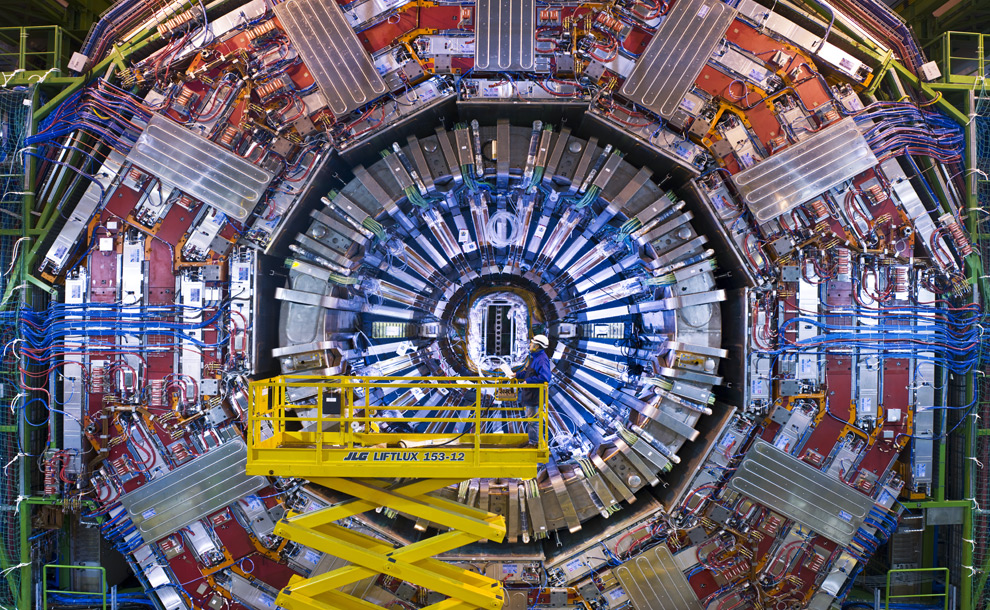
Particle physics usually has a hard time competing with politics and celebrity gossip for headlines, but the Higgs boson has garnered some serious attention. That's exactly what happened on July 4, 2012, though, when scientists at CERN announced that they'd found a particle that behaved the way they expect the Higgs boson to behave. Maybe the famed boson's grand and controversial nickname, the "God Particle," has kept media outlets buzzing. Then again, the intriguing possibility that the Higgs boson is responsible for all the mass in the universe rather captures the imagination, too. Or perhaps we're simply excited to learn more about our world, and we know that if the Higgs boson does exist, we'll unravel the mystery a little more.
In order to truly understand what the Higgs boson is, however, we need to examine one of the most prominent theories describing the way the cosmos works: the standard model. The model comes to us by way of particle physics, a field filled with physicists dedicated to reducing our complicated universe to its most basic building blocks. It's a challenge we've been tackling for centuries, and we've made a lot of progress. First we discovered atoms, then protons, neutrons and electrons, and finally quarks and leptons (more on those later). But the universe doesn't only contain matter; it also contains forces that act upon that matter. The standard model has given us more insight into the types of matter and forces than perhaps any other theory we have.

Thursday, August 4, 2016

what is a spore?

Ans 1: 
spore
noun
    The definition of a spore is a small organism or a single cell being that is able to grow into a new organism with the right conditions.
    An example of a spore is a flower seed.
Ans 2:
spore
  1. BIOL. any of various small reproductive bodies, usually consisting of a single cell, produced by bacteria, algae, mosses, ferns, certain protozoans, etc., either asexually (asexual spore) or by the union of gametes (sexual spore): they are capable of giving rise to a new adult individual, either immediately or after an interval of dormancy
  2. any small organism or cell that can develop into a new individual; seed, germ, etc.
Origin of spore
Modern Latin spora ; from Gr, a sowing, seed, akin to speirein, to sow ; from Indo-European base an unverified form (s)p(h)er-, to strew, sow from source spread, sprout
sporedspor′ing
to bear or develop spores
Ans 3:
spore
noun
  1. A small, usually single-celled reproductive body that is resistant to adverse environmental conditions and is capable of growing into a new organism, produced especially by certain fungi, algae, protozoans, and nonseedbearing plants such as mosses and ferns.
  2. A megaspore or microspore.
  3. A dormant nonreproductive body formed by certain bacteria often in response to a lack of nutrients, and characteristically being highly resistant to heat, desiccation, and destruction by chemicals or enzymes.

What is 4G?

Coverage logo4G is the fourth generation of mobile phone technology and follows on from 2G and 3G.
2G technology was suitable for making calls and sending text messages while 3G makes it possible to access the internet more effectively through your mobile phone.

What to expect from 4G?

4G services should make it much quicker to surf the web on your mobile, tablets and laptops - speeds will be nearer to what you currently experience with home broadband.
Because of this, 4G is ideally suited for services which demand more capacity like video streaming, mapping and social networking sites.
For the typical user, download speeds of initial 4G networks could be around 5-7 times those for existing 3G networks.
This means a music album taking 20 minutes to download on a 3G phone and just over 3 minutes on 4G. This is based on existing 3G speeds being 1Mbit/s on average and 4G speed being 6Mbit/s (average of 5 and 7 times faster).

What will 4G coverage be like?

Ofcom has designed the 4G auction in a way that will see mobile broadband rolled out to at least 98% of people in villages, towns and cities across the UK. This is for indoor coverage; however, given that it is easier to provide coverage outdoors, a network meeting this obligation is likely to cover more than 99% of the UK by population when outdoors.
Ed Richards, Ofcom Chief Executive, said: 'As a direct result of the measures Ofcom is introducing, consumers will be able to surf the web stream high-quality videos and download big files on their mobile device from almost every home in the UK.'

What is 3G broadband?

What is 3G? article header imageThe term 3G internet refers to the third generation of mobile phone standards, as set by the International Telecommunications Union (ITU). 3G technologies allow mobile operators to offer more service options to their users, including mobile broadband.
3G broadband offers greater flexibility and services by making more efficient use of mobile bandwidth than its predecessor 2G. And although faster, newer 4G technology is now available in the UK, 3G remains the UK's dominant mobile broadband technology.
The relationship between 2G and 3G is similar to that of dial-up and broadband, or terrestrial TV and digital TV. In all of the latter examples, greater spectral efficiency has enabled more consumer choice and a more effective service. Simply put, more data can be transmitted faster.

3G broadband

3G enables devices such as mobile phones and mobile dongles to deliver broadband-speed internet. Even the lowest-end, cheapest mobile phones are 3G enabled, making it easy to check emails and browse the web on the go.
Mobile broadband via dongles and smartphones has taken off extremely fast. Mobile broadband allows customers to browse the internet, check email and download files, music and video clips from their laptops and PCs wherever there is coverage.
3G is made possible by two complementary technologies - HSDPA and HSUPA (high speed download and upload packet access, respectively). These technologies enable mobile broadband users to access download speeds of up to 21Mb and upload speeds of up to 1.76Mb via a mobile dongle, USB modem or MiFi.